The heavens declare the glory of God;
the skies proclaim the work of his hands.
-Psalm 19:1

Thursday, November 12, 2009

Historic flooding event in process on the mid-Atlantic coast

SKY WATCH FRIDAY time! Welcome all sky fans!!! I truly appreciate your visit and comments. I might not have time to respond to you, but I will try my best to visit!!!

Our hosts: Klaus Sandy Sylvia Wren Louise Fishing Guy

Thanks, also,to Dot and Tom, who were instrumental in the success of this blogging event. You should definitely come fly with us!
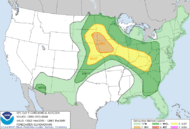
By now, most of you have heard of the huge coastal storm that is inundating the mid-Atlantic coast, most likely causing a historic flooding event, as the remnants of Ida merge with a high pressure system, creating a powerful pressure gradient, which is currently generating tropical storm force winds, causing ferocious waves, dropping buckets of rain and raising water levels, leading to flooding. The graphic the the left demonstrates the warnings and advisories being issued by the National Weather Service. You can click on the image for an updated depiction. Currently, there is flooding along the coast of North Carolina and Virginia from the surge combined with high tide overnight. Unfortunately, we expect that trend to move up the coast as subsequent high tides occur and the very slow storm motion, which in and of itself is going to cause rainfall totals 3x greater than a typical total rainfall for a wet November. Almost 10 inches have already been reported in some places.Precipitation

This system is offering basically the most destructive elements of a hurricane, without it being a hurricane. The areas affected will have flooding far inland due to excessive rainfall, which will be bad, but as the water level of the coastal water rises (storm surge--the pressure gradient will be drawing in storm surge), the waves grow in height, and high tide approaches again (4-5PM today), we can expect a devastating flooding event.

THE GREATEST THREAT FOR SEVERE FLOODING CAN BE EXPECTED DURING THE HIGH TIDE CYCLES THIS AFTERNOON AND FRIDAY MORNING.
Please join me in praying for all those who will be impacted (or have already been impacted) by the system formerly known as Ida, now just a no-name storm.
MOST FLOOD DEATHS OCCUR IN AUTOMOBILES. NEVER DRIVE YOUR VEHICLE INTO AREAS WHERE THE WATER COVERS THE ROADWAY. FLOOD WATERS ARE USUALLY DEEPER THAN THEY APPEAR. JUST ONE FOOT OF FLOWING WATER IS POWERFUL ENOUGH TO SWEEP VEHICLES OFF THE ROAD. WHEN ENCOUNTERING FLOODED ROADS MAKE THE SMART CHOICE...TURN AROUND...DON'T DROWN™
God bless those involved in the coastal storm.

3:20PM EST Update: Unfortunately, the remnant low of Ida has aligned with high tide to create a nightmare scenario. Fellow storm chaser and Southern Weather Brigade member, Mikey is located about 1/4 mile from the coast in Norfolk. Please include his family and friends in your prayers.

~Dewdrop

Wednesday, November 11, 2009

Could we have another "perfect storm"???

If you've seen "The Perfect Storm", you are familiar with the set-up I am about to describe, which is actually the set-up which could occur on our east coast today and tomorrow. Yesterday, we saw Hurricane Ida, become a Tropical Storm and make landfall in Alabama. A slight surge occurred causing some flooding. The moisture was pulled away from the center of circulation as the system became extra-tropical. The remnants of extra-tropical Depression Ida continue to push east, even this morning, as a significant low, being pushed off shore by a high pressure to the northwest.Here's the problem, sitting off the coast is an area of low pressure, which has a low likelihood of development, but could merge with the remnants of Ida to form a powerful low pressure system, as it continues to move to the northwest.Hypothetically, as the newly merged low pressure system (with its counter clockwise motion) were to move to the northwest and interact with the high pressure system (with its clockwise motion), a pressure gradient would set up. Link
The pressure gradient would force the air through the two fronts amplifying the impact. Back in 1991, when this occurred, it was referred to as "the perfect storm" or "no-name storm" or "The Halloween Nor'easter of 1991.

The 1991 Perfect Storm, also known as the No-Name Storm, was an unusual nor’easter which was extratropical, and absorbed one hurricane, and ultimately evolved into a small hurricane within an extratropical system late in its life cycle. The initial area of low pressure formed across Indiana before moving offshore of Atlantic Canada, where the cyclone reached its peak intensity. The unnamed hurricane of 1991 was the last tropical cyclone of the 1991 Atlantic hurricane season, and its fourth hurricane. By November 2, Atlantic Canada experienced the effects of a landfalling tropical storm. Damage totaled $208 million (1991 USD)[1] and the death toll climbed to 12 people including 6 onboard the Andrea Gail and one Air National Guard pararescue jumper, TSgt Arden "Rick" Smith. Most of the damage occurred while the storm was extratropical.

The Halloween Nor'easter of 1991, as an extratropical cyclone (today's case would be Ida), with its associated high winds from the pressure gradient between the high to its northeast and its low pressure center (sound familiar???), created large waves. Canadian buoy 44137 reported a wave height of 100.7 feet October 30. NOAA buoy 44011 reported maximum sustained winds of 49 knots (56 mph) with gusts to 65 kt (75 mph) and a significant wave height (average height of the highest waves) of 39 feet. (The central Atlantic coast of the US is under an imminent threat.)

It lashed northeastern U.S. with a storm tide of more than 13 ft above a storm surge of approximately 5 ft, and piled on top of that 30 ft waves. The worst of the storm stayed offshore. Duxbury Beach, Massachusetts had gusts up to 85 mph.
The "perfect storm" moniker was coined by author and journalist Sebastian Junger after a conversation with NWS Boston Deputy Meteorologist Robert Case in which Case described the convergence of weather conditions as being "perfect" for the formation of such a storm.
Well, here comes the potential for the perfect conditions again. It could happen similar to the events of 1991. Wouldn't that be interesting??? Regardless, the shores of North Carolina, South Carolina and Virginia can expect flooding and wind.

Have a blessed day!
~Dewdrop

Tuesday, November 10, 2009

Ida downgraded to extra-tropical as she moves ashore

THE CENTER OF TROPICAL STORM IDA MADE ITS FIRST LANDFALL AROUND 540 AM CST...1140 UTC... ON DAUPHIN ISLAND ALABAMA... WITH MAXIMUM SUSTAINED WINDS OF 45 MPH... 75 KM/HR.

THE CENTER OF IDA MADE ITS SECOND LANDFALL AROUND 700 AM CST... 1300 UTC... JUST TO THE NORTHWEST OF BON SECOUR ALABAMA.
Fortunately for us here in south Georgia, a great deal of the associated moisture was quickly lifted up to our north into that frontal boundary. North Alabama and Georgia were both inundated with heavy rain as the racing outer bands of Ida were ripped away from the core circulation. Fortunately, the fast movement should help in preventing too much horrific flooding. There is a band currently training over a good part of south Georgia. I am expecting that to move my way and cause a mess down here, but it shouldn't be too terribly bad. In any case, Turn Around, Don't Drown™. That line is actually presenting itself well on satellite. The now, extra-tropical Depression Ida is expected to traipse across the south and eject on the east coast and perhaps head south toward the Bahamas.The models pretty much look like spaghetti at this point, so it's anyone's guess. I like the one that has it doing a loop-de-loop in West Virginia and then racing out into the Atlantic. I think the models pushing it southward are accurate. The National Hurricane Center shared this suspicion and have decided on this as their official forecast.It looks like a wet day for most of Georgia.

Looky, looky, is there more on the horizon...? (Not likely!)Have a beautiful day!
~Dewdrop

Monday, November 09, 2009

Tropical Storm Ida Breezes

Well, you can see on this image that persistent Tropical Storm Ida is bearing down strongly on the Gulf Coast. The expectation is that there will be wind and rain, causing power outages and flooding, a storm surge of 3-5 feet is anticipated. Locally, we are starting to get increased breezes, southerlies and easterlies competing for power in my neck of the woods, as the outer bands of Tropical Storm Ida press inland.
Being in the northeast quadrant of a land falling tropical storm, there is a possibility of some weak and brief spin-ups (tornadoes), but our main concern her is the potential for lots of rain as Ida catches the frontal boundary and hangs a right, which is the forecast.Yep, we are definitely in the cone; looks like rain!

~Dew

What's Ida going to do???

Yes, the now Hurricane Ida is bearing down on the US Gulf Coast, losing intensity as she makes her way toward us. She has lost some of her beautiful (yes, I am weird) structure. She has lost a tremendous amount of symmetry and intensity over this morning. Hurricane Ida reached category 2 strength yesterday, and as she has journeyed northward into an area of cooler waters and a more hostile environment for such tropical activity, we see her losing structure and strength. As of this morning's most recent advisory, Hurricane Ida is a category 1 hurricane, with her sites set on the Pensacola/Mobile area for a full impact tonight.With Ida rapidly losing intensity, the big issue is less where she'll hit directly, but how much rain she carries with her, and her interaction and absorption with the front now making its way across the US. The eastern US will most likely all be impacted in some way by the now Hurricane Ida. Granted, I don't think it will be nearly as dramatic as TWC is making it out to be. Given the timing, it doesn't look like I will be chasing this November hurricane. If only it was moving in this weekend...

Have a great day!
~Dewdrop

Friday, November 06, 2009

What's in store for Ida?

Regarding the now, Tropical Depression Ida, currently flooding out Honduras and after slamming into Nicaragua as a hurricane, this is what the models see as the potential trajectory for her future. I am bothered by the westward training, as I don't really think that is a realistic path...

THE INTERACTION OF IDA WITH THAT TROUGH IS CAUSING A WIDE VARIETY OF MODEL SOLUTIONS... RANGING FROM A FASTER CENTRAL GULF OF MEXICO LANDFALL TO IDA REMAINING SEPARATE FROM THE TROUGH AND STAYING OVER THE CENTRAL GULF WATERS. ALTHOUGH SOME OF THE MODELS HAVE SHIFTED WESTWARD SINCE THE LAST RUN...CLIMATOLOGY AND THE FORECAST STRONG UPPER- LEVEL SOUTHWESTERLY WINDS SUGGEST THE EASTERN SOLUTIONS ARE LIKELY CLOSER TO REALITY.
... but neither does the National Hurricane Center, who have a cone extending into my neck of the woods.Which might put it in the... big bend of Florida. For me, that would make it a chaseable event. I can get to the big bend in time to intercept, but I can't make it there Thursday... sigh. With the frontal boundary bearing in, though, a greater likelihood (in my very strong and amateur opinion) would be closer to Tampa... as a strong TS or extratropical storm.
THERE CONTINUES TO BE A LARGE DISAGREEMENT AMONG THE MODELS ON HOW MUCH INTENSIFICATION TO EXPECT WITH IDA. THE STATISTICAL GUIDANCE GENERALLY SHOWS A RATHER MODEST AMOUNT OF RESTRENGTHENING... WHILE THE REGIONAL HURRICANE MODELS SUGGEST THAT IDA WILL BECOME A
HURRICANE AGAIN.
This is how she currently looks over Honduras, as she grasps for her place over water.That's Ida.

Have a great weekend!!!
~Dewdrop

Thursday, November 05, 2009

Hurricane Ida arrives in the Caribbean

SKY WATCH FRIDAY time! Welcome all sky fans!!! I truly appreciate your visit and comments. I might not have time to respond to you, but I will try my best to visit!!!

Our hosts: Klaus Sandy Sylvia Wren Louise Fishing Guy

Thanks, also,to Dot and Tom, who were instrumental in the success of this blogging event. You should definitely come fly with us!Well, with all the beautiful skies I've been having lately, it surprises me that I didn't have any current pics that I haven't already shared, so I hit the archive. This is a wonderful winter sunset back from 2007. There are several things about this image that I really love. 1. The color, the golden amber glow was a wonderful way to end the workday. 2. The way the sun appears as a brilliant ball of fire, close enough to reach out and touch. 3. The way it appears to be melting the sky beneath with is golden yellow whirling below and the coral flash wafting above. 4. The golden glowing rim of cloud... telling me some clouds have a golden lining. 5. The way the light of the setting sun hits the contrail in the upper left of the shot, glowing brilliantly back at the beaming sun. 6. The trees showing their vulnerability as they lay barren against the cold winter, awaiting with eagerness, the newness that arrives in spring.

Lo and behold, we've got the 3rd hurricane of the Atlantic Basin's 2009 season. Yes, you read that correctly, here we are November 5th, and we are just on number 3. Can you name them? The first made landfall in Newfoundland, and actually took the life of a little girl in Maine, and that was Hurricane Bill (what a name!). The other was Hurricane Fred. Remember that one? No? Well, he hung out around the Cape Verde Islands, but he did not make landfall. Both reached major hurricane status during their lives. Now, we have Hurricane Ida. She formed off the coast of Nicaragua, and has (as of the most recent advisory) made landfall in that treacherous mountainous country, Nicaragua. When Hurricane Ida emerges on the other side, she is expected to gain strength over water... and then emerge into the Gulf of Mexico. All Gulf coast interests should be keeping their eyes on Ida. We will plan an intercept if she makes it up during next weekend. It's too far out to know how the models will hold up. What the models are saying...

Have a blessed day!
~Dewdrop

Wednesday, November 04, 2009

We've got Tropical Storm Ida...

We've got Tropical Storm Ida, packing winds of 60mph, but look at this...She's expected to make it to the Gulf of Mexico and strengthen after a wet assault on Nicaragua and Honduras.

~Dew

Don't turn your back on the tropics just yet

Well, looky looky, down in the Caribbean Sea, we have an area of low pressure that the National Hurricane Center has identified as having a high probability of development into a tropical cyclone. It's been a while since we have talked about anything going on in the Atlantic Basin... it's been a dud season, but here we are with a late bloomer, which is actually presenting itself rather nicely on satellite.It looks very well organized to me, and I wouldn't be surprised if after reconnaissance, they skip tropical depression and immediately call it Tropical Storm Ida. You might be thinking... but the season is over... not so, the Atlantic Basin Hurricane Season lasts until November 30, and tropical cyclones have formed beyond that date in the past, so it's mostly just a time frame for expected occurrence.

Yesterday, I was leaving work and there was an amazing contrail that had feathered out to look like a giant spine (crooked like mine) across the huge expanse of sky. It was very cool, so... you know what I had to do...Then, last night, we had a beautiful altocumulus obscured moon with full and brilliant corona. I just sat back and enjoyed it this time.

Have a beautiful day!
~Dewdrop

Tuesday, November 03, 2009

Mooooon....

Ok, so I got into a debate with Mini-Dew the other night about the state of the moon. You see, when it is close to full, she calls it full, and I tell her that only once in every 28 day cycle is it completely full. She doesn't believe me.Outside of the one day of full moon, there are varying stages of fullness, which might appear full, but we cannot see the full face of the moon. Yesterday was our full moon for the month. The next won't occur until December 2. If you click on the graphic above, you will see the year of moon phases.
In honor of the phases, I decided to post my shots of 2008's lunar eclipse, where the phases are mimicked in the course of the eclipse, which is caused by the earth passing briefly between the sun and a full moon.

February 2008 lunar eclipse ― The only total lunar eclipse of 2008 occurred on February 21, 2008, beginning at 01:43 UTC, visible from Europe, the Americas, and Africa. The next total lunar eclipse will occur on December 21, 2010.
My favorite stage is when the moon is fully eclipsed and it glows red in the shadow.
The following scale (the Danjon scale) was devised by André Danjon for rating the overall darkness of lunar eclipses:[3]

L=0: Very dark eclipse. Moon almost invisible, especially at mid-totality.
L=1: Dark Eclipse, gray or brownish in coloration. Details distinguishable only with difficulty.
L=2: Deep red or rust-colored eclipse. Very dark central shadow, while outer edge of umbra is relatively bright.
L=3: Brick-red eclipse. Umbral shadow usually has a bright or yellow rim.
L=4: Very bright copper-red or orange eclipse. Umbral shadow is bluish and has a very bright rim.
Makes you want to howl, doesn't it?

Aside from that, temperatures across the nation start to plunge into a more seasonally appropriate range, as a high pressure line-up rolls in taking over almost the entire country with clear skies and cool breezes.I wouldn't expect this too change anytime too soon, which is good news for those areas recovering from recent flooding.

Have a great day!
~Dewdrop

Monday, November 02, 2009

Hope everyone had a Happy Halloween!

I was outside yesterday evening, packing up some of the Halloween decorations that we were amazingly able to squeeze into only two boxes (go us!), when the moon caught my fancy. The display of clouds had caught my eye all day, with the altocumulus, cirrocumulus, and cirrus all blending together in the sky, it looked like the approach of fall. As the moon approached fullness (which is tonight, by the way) and the clouds created a drapery of puffy altocumulousness, I was struck by the amber corona racing into the sky around the moon. It was fascinating, so I quite literally dropped everything and raced outside with my tripod (I don't dare shoot night shots without my tripod).

We had a wonderful time on Saturday. Fortunately, our local sprinkle showers didn't start until after the trick-or-treating hay ride... whew! We had a great time, lots of friends, lots of food, lots of fun! I think everyone had a great time... and hopefully, everyone's bellies did ok. Here are some of my favorite pics.Yes, they TPed by living room! LOL!

Hope everyone had a safe and fun Halloween!!!~Dewdrop

Thursday, October 29, 2009

Iridescence in the sky

SKY WATCH FRIDAY time! Welcome all sky fans!!! I might not have time to respond to you, but I will try my best to visit!!!

Our hosts: Klaus Sandy Sylvia Wren Louise Fishing Guy

Thanks, also,to Dot and Tom, who were instrumental in the success of this blogging event. You should definitely come fly with us!

Oh boy, have I got a treat for you! I actually shot it this morning. It was such a joy to catch a glimpse once again of yet another fairly uncommon phenomena. I have researched cloud iridescence in the past, but I have never witnessed it first-hand, that I can recall. Cloud iridescence occurs when light (generally it occurs in the clouds close to the sun's location in the sky) hits small individual water droplets or even small ice crystals and the iridescence (like a smudged rainbow in the clouds)is a diffraction phenomenon, where light is apparently bending around the small water droplets and spreading out its waves past small openings, not to be confused with the refraction phenomenon, where light's direction is changed due to a change in velocity, such as when light encounters a large impenetrable area, creating an almost angled reflection. Such refraction occurs when light hits larger quantities of water and will tend to generate a halo, arcs or perhaps a rainbow. Those are different effects. Diffraction is almost a smudging of light, where refraction displaces its original path.

Cloud iridescence or irisation is the occurrence of colors in a cloud not dissimilar to those seen in oil films on puddles. It is fairly uncommon phenomena and is usually observed in altocumulus, cirrocumulus and lenticular clouds but very rarely in Cirrus clouds.
In my case, the cloud iridescence occurred in cirrocumulus clouds. To read more about cloud iridescence, feel free to check out this link. These little love letters from God thrill my heart.

In weather, a storm system that dropped feet of snow (I hate that word) in some places in and around Colorado, has now created a severe weather scenario in the plains. The front has turned into a squall line of severe weather for some, as it races across the country as a virtual wall of wind and rain.

Have a beautiful day!
~Dewdrop